Rattan vs Bamboo vs Fiber Reed Diffuser Sticks: Which Is Best for Scent Throw?
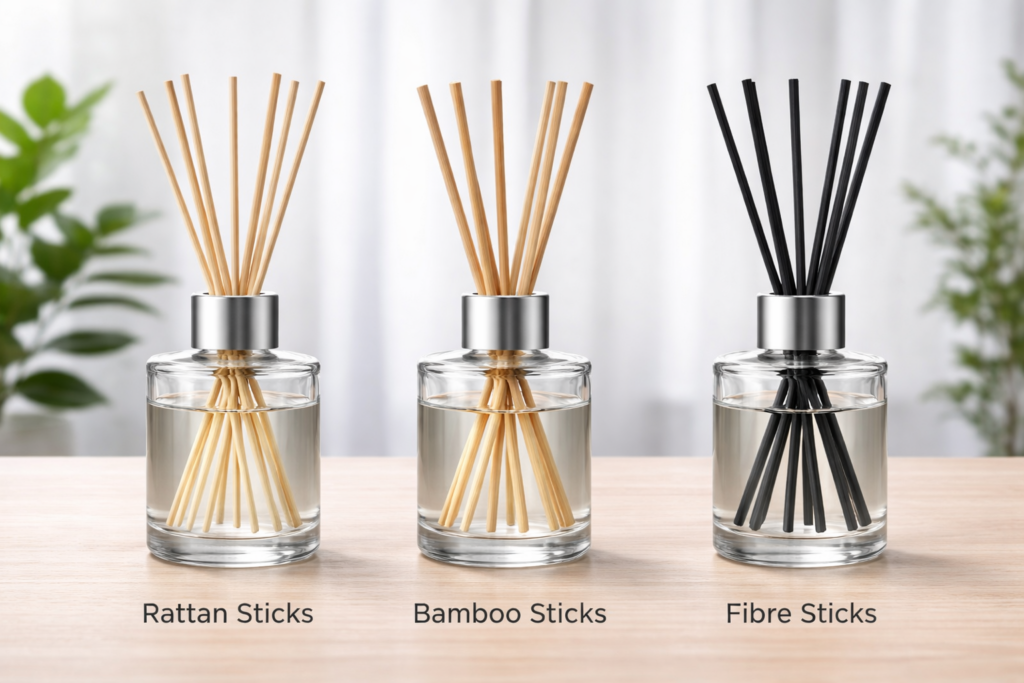
Reed diffusers scent a space by using simple reeds. However, the reeds used in a diffuser vary, as rattan, bamboo, and fibre reeds each offer different characteristics that influence their scenting efficiency and the level of maintenance required to keep them working properly.
Rattan Sticks
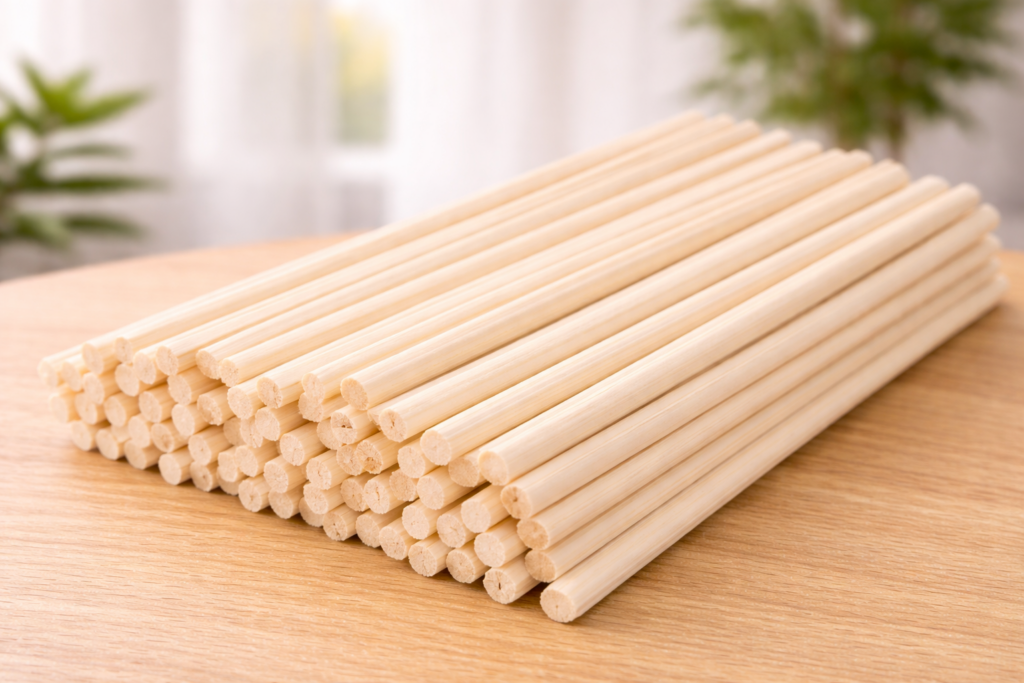
Manufacturers make these reeds from the rattan palm plant. They contain numerous small channels that resemble straws, which absorb fragrance oils and release them into the air. For the last several years, rattan reeds have been the standard in the world of reed diffusers. They provide an organic look to the space, and the scent tends to linger subtly over time. To maintain performance, users must flip rattan reeds periodically, as the reeds can dry out at the top. Eventually, the channels can become clogged with fragrance oils used in the diffuser, so users need to replace the reeds every few months to ensure the reed diffuser continues to function properly.
Pros: Natural and environmentally friendly (biodegradable); excellent oil absorption; can work with most oils used in the diffuser.
Cons: Periodically must flip the reeds to ensure proper scenting; can get clogged with oils; quality can vary depending on the batch.
Bamboo Sticks
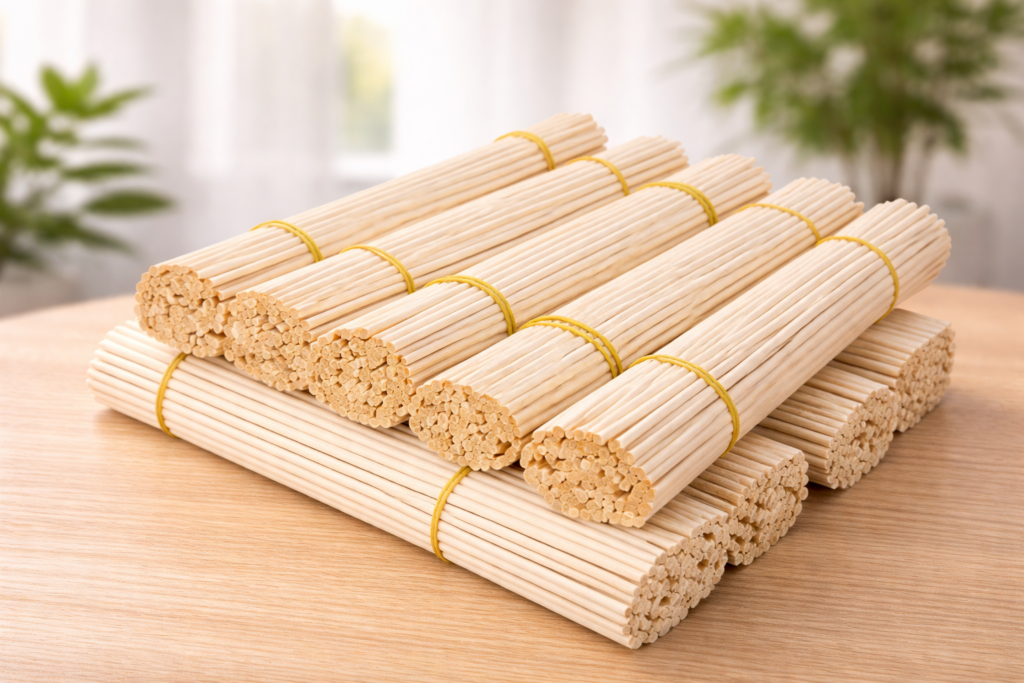
Another natural diffuser option is bamboo sticks. Bamboo sticks are attractive because they are environmentally friendly and inexpensive. However, bamboo sticks are generally less effective than other sticks for diffusing scents. This reduced performance occurs because bamboo sticks have internal “barriers” that do not allow scents to flow as freely as they should. As a result, fragrance movement is more restricted. Bamboo sticks are denser and less porous than other sticks. For best results, users should flip and replace bamboo sticks frequently, such as every few months. Bamboo sticks become saturated with scent quickly but allow limited diffusion. Nevertheless, bamboo sticks remain popular because they are environmentally friendly and sustainable, which benefits the planet.
Pros: Inexpensive; environmentally friendly and sustainable – bamboo is a fast-growing renewable resource.
Cons: Bamboo sticks are not as porous and have “barriers” that do not allow scents to flow as well as they should; requires frequent flipping and replacement.
Fibre Sticks
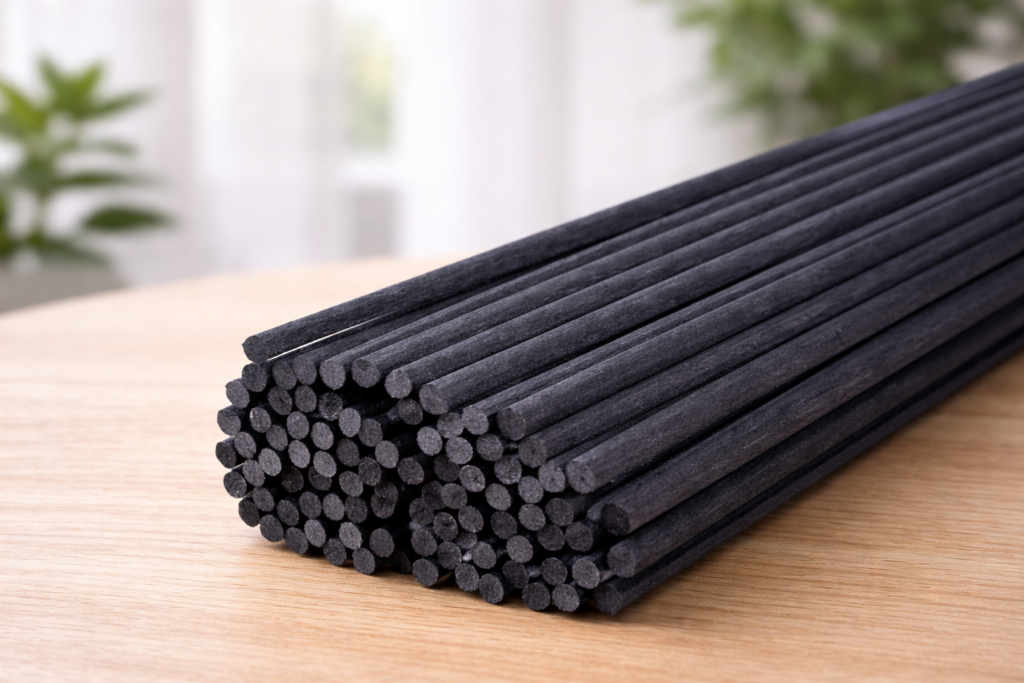
Manufacturers design fibre diffuser sticks as artificial sticks specifically for fragrance diffusion. They can be made from materials such as polyester and cotton, which are tightly packed together. Unlike rattan and bamboo sticks, fibre sticks feature consistent, open pores, allowing fragrance to move efficiently from the bottom to the top and produce a stronger scent diffusion. One key advantage of fibre diffuser sticks is that users do not need to turn them, as fragrance continuously wicks upward and evaporates. They also do not clog, thanks to their uniform structure. Although fibre sticks deliver a very strong fragrance, the oil used in the diffuser is consumed slightly faster.Pros: Strong fragrance diffusion; does not require turning; does not clog; long-lasting and comes in different colours.
Pros: Strong fragrance diffusion; does not require turning; does not clog; long-lasting and comes in different colours.
Cons: Not natural; slightly more expensive; oil is consumed faster.
Comparing Rattan, Bamboo, and Fibre Sticks
The table below summarizes the key differences between these three types of diffuser sticks:
Feature |
Rattan Sticks | Bamboo Sticks | Fibre Sticks |
Material |
Natural rattan palm (renewable) | Natural bamboo wood (renewable) | Synthetic fiber (polyester, cotton blend) |
Channels/Pores |
Many open channels for oil flow | Interrupted by nodes; restricted flow | Engineered uniform pores for optimal flow |
Scent Throw |
Slow and subtle release; moderate throw | Weak throw due to limited absorption | Strong and immediate scent throw |
Maintenance |
Flip sticks periodically to refresh scent | Flip often; replace every few months | Little to no flipping needed (low maintenance) |
Longevity |
Lasts a moderate time; can clog eventually | Short lifespan; clogs faster if oil is thick | Lasts until oil is gone; consistent performance |
Eco-Friendliness |
Excellent: biodegradable & sustainable | Excellent: biodegradable & sustainable | Poor: not biodegradable (plastic-based) |
Cost |
Medium – reasonably affordable | Low – very cheap option | High – slightly more expensive |
Which Type of Reed Stick is Best?

The best type of diffuser stick is, of course, subjective, depending on what is most important to you. If you wants the strongest scent with the least amount of work, fibre sticks can be considered the best, as these are designed for this purpose and will provide the best scent throw with the least maintenance required.
If you wants an all-natural product with a light, ongoing scent, then the best option is the rattan sticks. These provide a traditional diffuser with the added benefit of being all-natural, although the user must be mindful of flipping the sticks from time to time and replacing them when saturated. Rattan reeds provide the best balance between functionality and natural appeal.
The use of bamboo sticks would work well if a tight budget is a priority, or if going green is the most important factor. It will work well to fragrance a small space, though, so keep that in mind in terms of the strength of the fragrance. Bamboo skewers can work well for a homemade diffuser, though they will not work well to disperse the scent at all compared to the other options, such as rattan and fibre reeds, due to the lack of pores on a bamboo skewer. Bamboo sticks would be a last resort for a homemade diffuser, as the other two options, rattan and fibre, will work much better than a bamboo stick.
To sum it all up, the best option for a strong fragrance would be a fibre reed, a close second would be a rattan reed, and then a bamboo stick would work well if the cost and going green are the priorities, though a strong fragrance would not be a priority in this case. Many modern-day diffuser enthusiasts would say that a fibre reed would be the way to go to get the strongest and longest-lasting scent in the home.
FAQ
Q: Can you use bamboo skewers for a reed diffuser?
Yes, you can use bamboo skewers for reed diffuser sticks, but they are not the best material for the job. This is because they have fewer pores for the absorption of the oil, and the scent will not travel far.
Q: What is the best material for reed diffuser sticks?
For the average person, the best material for reed diffuser sticks would be the fibre sticks because they offer the strongest scent release. However, if you are looking for something a bit more natural, the best material for reed diffuser sticks would be high-quality rattan sticks.
Q: Are rattan and reed the same?
In terms of diffusers, rattan sticks are part of a reed diffuser. “Reed” is a term used for diffuser sticks. Rattan is a common material for these diffuser sticks. Therefore, rattan and reed are often used interchangeably for diffuser sticks. However, reed can be defined as a part of a rattan or other plants’ inner cores. In terms of diffusers, rattan sticks are used as reed diffuser sticks.
Q: When should you replace rattan sticks in a reed diffuser?
Rattan sticks should be replaced when they are saturated or cannot effectively diffuse fragrances. It is advisable to change them every time you change your diffuser oil. In other words, it should be changed every 2-6 months. However, reeds tend to clog with old oils and dust. Therefore, replacing them will ensure a strong and fresh scent.